
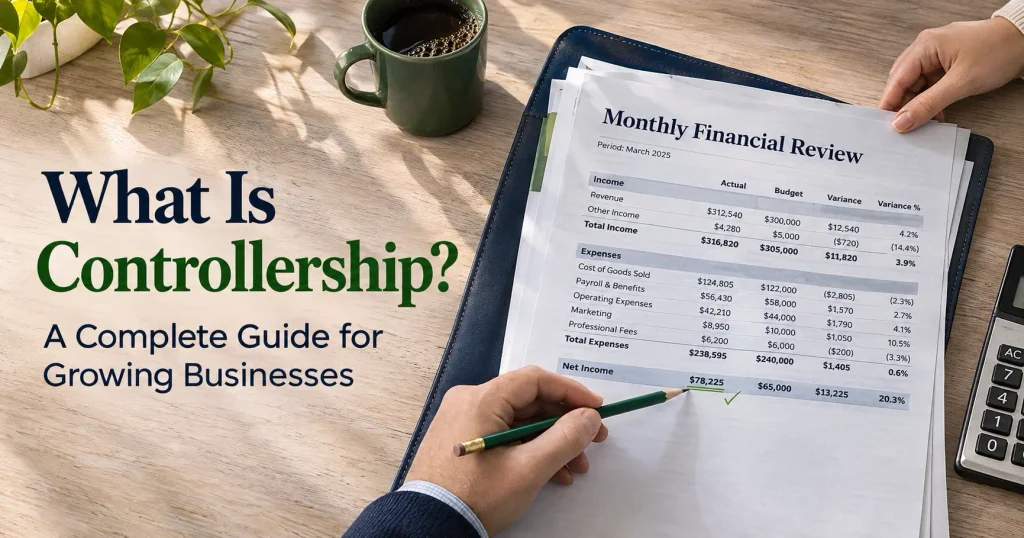
Managing business finances involves more than recording transactions and preparing tax returns. As a company grows, financial operations become more complex, making it increasingly important to maintain accurate financial records, monitor cash flow, strengthen internal controls, and understand overall business performance.
This is where controllership becomes valuable.
Controllership is the process of overseeing a company’s accounting operations, financial reporting, internal controls, and financial management procedures. It helps business owners understand where their money is going, identify potential financial problems, and make informed decisions based on reliable financial information.
Whether you operate a small business, an established company, or a growing organization, understanding controllership can help you build stronger financial processes and prepare for sustainable growth.
In this guide, we explain what controllership means, the responsibilities of a financial controller, the benefits of outsourced controllership, and how to determine whether your business needs professional financial oversight.
What Is Controllership in Business?
Controllership refers to the financial oversight and management of a company’s accounting functions. It ensures that financial information is accurate, reporting processes are consistent, and accounting procedures support the company’s operational and financial goals.
A controllership function typically involves supervising accounting activities, reviewing financial statements, monitoring internal controls, managing the month-end closing process, and supporting budgeting and forecasting.
Unlike basic bookkeeping, which primarily focuses on recording financial transactions, controllership takes a broader approach to financial management.
For example, bookkeeping may record how much a business spends on operating expenses. Controllership examines those expenses, reviews spending patterns, identifies potential inconsistencies, and helps management understand how expenses affect profitability.
In simple terms, bookkeeping records your financial activities, while controllership provides the oversight needed to understand and manage them effectively.
What Does a Financial Controller Do?

A financial controller oversees the accounting and financial reporting functions of a business. Their role is to maintain financial accuracy, improve accounting processes, and provide management with reliable financial information.
Here are some of the key responsibilities of a financial controller.
1. Financial Reporting and Analysis
Financial controllers oversee the preparation and review of financial statements, including:
- Profit and loss statements
- Balance sheets
- Cash flow statements
- Monthly financial reports
- Management performance reports
These reports help business owners understand revenue, expenses, profitability, liabilities, and overall financial performance.
2. Internal Controls and Risk Management
Internal controls help protect company assets and reduce the risk of accounting errors, unauthorized transactions, and financial discrepancies.
A controller reviews existing financial procedures and helps establish appropriate approval processes, account reconciliations, documentation standards, and financial checks.
3. Month-End and Year-End Closing
Closing the books regularly is essential for maintaining accurate financial information.
A controller oversees activities such as:
- Reviewing account reconciliations.
- Checking outstanding transactions.
- Reviewing journal entries.
- Verifying account balances.
- Preparing financial statements.
- Investigating discrepancies.
A structured closing process helps businesses access financial reports on time and make decisions using current information.
4. Cash Flow Management
A profitable business can still experience cash flow problems if incoming and outgoing payments are not managed properly.
Financial controllers help monitor cash flow, review accounts receivable and payable, identify potential liquidity issues, and support financial planning.
5. Budgeting and Financial Forecasting
Financial controllers help businesses prepare budgets and evaluate actual financial performance against planned results.
They can identify unexpected spending, monitor revenue trends, and provide financial information that supports future planning.
6. Accounting Team Oversight
As businesses grow, accounting responsibilities may be distributed across multiple employees or departments.
A controller helps oversee accounting activities, review work for accuracy, improve workflows, and establish consistent financial procedures.
Why Is Controllership Important for Growing Businesses?
Many business owners initially manage accounting through basic bookkeeping software or a small internal team. However, as revenue, employees, customers, and operating expenses increase, financial management becomes more demanding.
Without proper oversight, businesses may experience delayed financial reports, inaccurate account balances, poor expense visibility, and difficulties managing cash flow.
Controllership helps address these challenges through structured financial management.
Some important benefits include:
Better Financial Visibility: Understand your company’s financial position through accurate and timely reports.
Improved Cash Flow Management: Monitor incoming payments, outstanding invoices, expenses, and upcoming financial obligations.
Stronger Internal Controls: Establish consistent accounting procedures and reduce the risk of errors and discrepancies.
More Informed Business Decisions: Use financial reports and performance analysis to evaluate business opportunities.
Organized Accounting Operations: Improve reconciliation, reporting, documentation, and month-end closing processes.
Support for Business Growth: Build financial systems that can adapt as your company expands.
For growing businesses, these benefits can make financial operations more organized and easier to manage.
What Is the Difference Between Bookkeeping and Controllership?
Bookkeeping and controllership are closely connected, but they serve different purposes within a company’s financial operations.
Bookkeeping focuses on recording and organizing financial transactions, while controllership provides broader oversight of accounting processes and financial reporting.
| Bookkeeping | Controllership |
|---|---|
| Records financial transactions | Oversees accounting operations |
| Reconciles bank accounts | Reviews reconciliation accuracy |
| Tracks income and expenses | Analyzes financial performance |
| Maintains financial records | Oversees financial reporting |
| Supports routine accounting | Strengthens internal controls |
| Organizes transaction data | Supports budgeting and forecasting |
Both functions are important. Accurate bookkeeping provides the financial information that controllership uses to evaluate performance and maintain reliable accounting processes.
Businesses with increasing financial complexity may benefit from having both functions working together.
What Is the Difference Between a Controller and a CFO?
A controller and a Chief Financial Officer (CFO) both contribute to financial management, but their responsibilities are different.
A controller generally focuses on accounting operations, financial reporting, internal controls, and maintaining the accuracy of financial information.
A CFO typically has a broader strategic role involving long-term financial planning, capital allocation, investment decisions, business strategy, and financial leadership.
For example, a controller may prepare and review monthly financial reports, while a CFO uses those reports to evaluate expansion opportunities, financing options, and long-term business objectives.
Growing companies may need controllership before they require a full CFO function. The right level of support depends on the company’s size, financial complexity, and management needs.
What Are Outsourced Controllership Services?
Outsourced controllership services allow businesses to access professional financial oversight without hiring a full-time, in-house controller.
Instead of managing every accounting responsibility internally, a business works with an external accounting team to oversee financial reporting, internal controls, reconciliations, budgeting support, and accounting procedures.
Depending on the company’s needs, outsourced controllership may include:
- Financial statement preparation and review.
- Month-end and year-end closing oversight.
- Internal control development.
- Cash flow monitoring.
- Budgeting and forecasting support.
- Accounting process improvements.
- Financial reporting and analysis.
- Accounting team supervision.
- Audit preparation and documentation support.
Outsourcing can be particularly useful for small and midsize businesses that need experienced financial oversight but do not yet require a full-time controller.
In-House Controller vs. Outsourced Controllership
| In-house controller | Outsourced controllership |
|---|---|
| Dedicated internal employee | External accounting professionals |
| Salary and employment expenses | Service-based engagement |
| Internal team integration | External financial oversight |
| Resources depend on one hire | Access to a broader accounting team |
| Fixed staffing structure | Potentially flexible service scope |
The best option depends on your company’s accounting workload, budget, reporting requirements, and need for ongoing financial support.
When Should a Business Consider Controllership Services?
Not every company needs professional controllership from the beginning. However, certain financial challenges indicate that additional accounting oversight may be beneficial.
Consider controllership services if:
Your Business Is Growing Quickly
Increasing revenue, employees, and operating expenses can make financial management more complicated. Additional oversight can help maintain consistent accounting processes.
You Receive Financial Reports Too Late
If monthly financial statements are consistently delayed, it may be difficult to understand your company’s current performance and respond to problems.
You Struggle With Cash Flow Visibility
Difficulty tracking receivables, payables, and upcoming expenses can create unnecessary financial pressure.
Your Accounting Processes Lack Structure
Unclear approval procedures, inconsistent reconciliations, and poor documentation can increase the risk of financial errors.
You Need Better Financial Planning
If you want to establish budgets, evaluate spending, or prepare for business expansion, professional financial oversight can help organize the information required for planning.
You Have an Accounting Team but Lack Oversight
Even businesses with bookkeepers and accounting employees may benefit from a dedicated professional reviewing financial processes and reporting accuracy.
How Can Controllership Help Improve Business Financial Performance?
Controllership does more than maintain accurate accounting records. It helps business owners understand the financial information behind their daily operations.
For example, a company may experience increasing sales but still struggle with cash flow. A controllership review can help management examine outstanding customer payments, operating expenses, payment schedules, and financial reporting to better understand the issue.
Similarly, if operating costs increase unexpectedly, reviewing expense categories and comparing actual spending against budgets can help identify areas that require attention.
With consistent financial oversight, business owners can make decisions based on reliable information rather than assumptions.
How Accounting to Scale Supports Business Controllership
Managing financial operations while running a growing company can become challenging. Business owners need accurate reporting, organized accounting processes, and dependable financial oversight to make confident decisions.
Accounting to Scale provides controllership services designed to help small and midsize businesses strengthen their financial operations.
Our controllership support includes financial reporting, internal controls, month-end closing, cash flow management, budgeting and forecasting, audit preparation, compliance oversight, and accounting team review.
We work with businesses to understand their financial processes, identify areas that need improvement, and establish more consistent accounting practices.
Whether you need better financial reporting, stronger internal controls, or ongoing oversight of your accounting operations, our team can help you determine the appropriate level of support.
Ready to bring more structure and clarity to your business finances?
Contact Accounting to Scale to discuss your accounting challenges and explore controllership solutions that align with your business needs.
Frequently Asked Questions About Controllership
1. What is the main purpose of controllership?
The main purpose of controllership is to oversee a company’s accounting operations, financial reporting, internal controls, and financial processes. It helps maintain accurate financial information and supports better business decisions.
2. What are the four main functions of controllership?
Four common controllership functions include financial reporting, internal controls, accounting operations oversight, and financial planning support. The exact responsibilities vary depending on the business.
3. Is controllership the same as accounting?
No. Accounting involves recording, classifying, and reporting financial transactions. Controllership provides broader oversight of accounting processes, reporting accuracy, internal controls, and financial operations.
4. Does a small business need a financial controller?
A small business may benefit from a financial controller when its accounting operations become more complex, financial reporting is inconsistent, or management needs stronger oversight without adding a full-time accounting executive.
5. What is included in outsourced controllership services?
Outsourced controllership can include financial reporting, month-end closing, account reconciliations, internal controls, cash flow monitoring, budgeting support, and accounting team oversight.
6. How much do outsourced controllership services cost?
The cost depends on business size, transaction volume, accounting complexity, reporting requirements, and the level of professional oversight required. A customized assessment can help determine the appropriate service scope and pricing.
7. Can controllership improve cash flow management?
Yes. Controllership can improve cash flow visibility by reviewing receivables, payables, expenses, financial reports, and cash flow trends. This helps business owners better understand upcoming financial needs.
8. When should a company outsource controllership?
A company may consider outsourcing when it needs experienced financial oversight but does not have enough work or resources to justify hiring a full-time controller.
